How VIE works
AI-Powered, Fleet-Wide
Asset Intelligence.
Most asset managers already know when a transformer is degrading. The question is whether they find out in a report or in an outage. VIE answers that question 3 to 6 months before the failure event — without shutting down a single asset.
The Industry’s Biggest Risk Is Not Asset Failure.
It's Decision Latency.
Data exists across every major transformer fleet in the world. Most of it arrives too late to act on. Periodic oil tests sample a transformer at one moment in time. Annual inspections catch degradation that is already advanced. By the time a maintenance team knows a transformer is failing, the failure window has often closed.
VIE changes that window.
The platform monitors every asset in your fleet, continuously, from the outside of the transformer. It identifies the physical signatures of failure months before conventional methods detect anything. Your team stops reacting to failures. It starts preventing them.
3 to 6 months.
That is the typical lead time between
a VIE detection and a failure event.
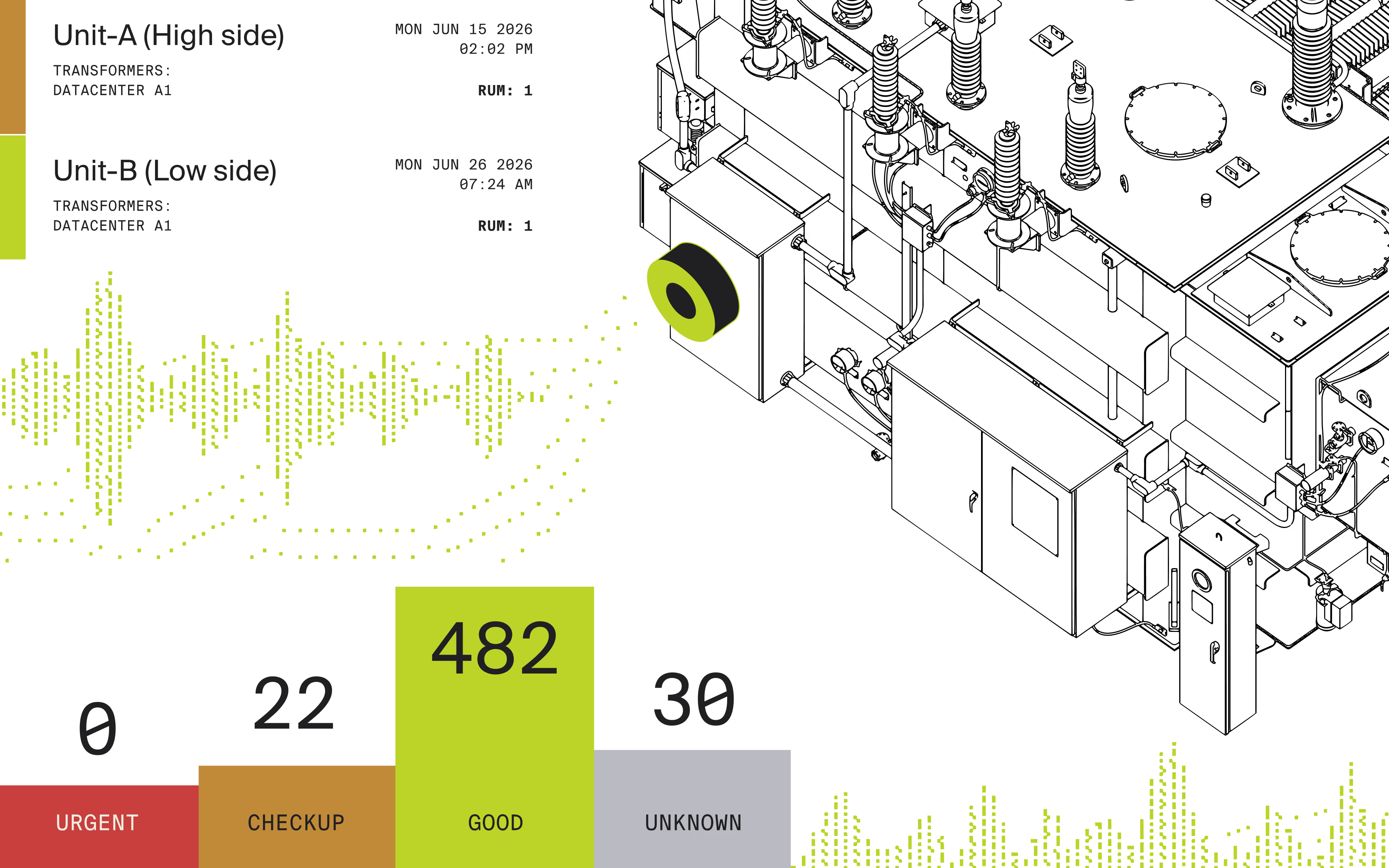
Four Layers. One Continuous Intelligence System.
VIE is not a monitoring tool that generates reports. It is an intelligence layer that learns your fleet, ranks your risk, and surfaces what needs attention — in real time, at scale.
The Sensor
The Sensor
External. Non-invasive. Always on.
VIE sensors mount to the outer surface of the transformer tank using two-part epoxy. The transformer staysenergized throughout installation. Nothing touches the transformer internals. Nothing interrupts service.
Each sensor captures tri-axial vibration and surface temperature simultaneously. It records data continuously— not on a schedule, not during a test window, not when a technician is present.
The Gateway
The Gateway
Local collection. Cloud delivery. 99.95% reliability.
Sensors transmit data to a VIE gateway via Bluetooth Low Energy. The gateway sends that data to the cloud via LTE or satellite. It requires no existing network infrastructure at the site. It works in substations, remote facilities, and offshore installations.
Since VIE launched, there has been one sensor failure and zero gateway failures. Gateway reliability: 100%.
The AI Platform
The AI Platform
Continuous analysis. Fleet-scale learning. Failure mode detection months out.
The cloud platform runs VIE’s AI and machine learning models against incoming vibration and temperature data around the clock. It learns what normal looks like for each specific asset, in each specific operating environment. It detects deviations that precede failure — not deviations from a generic threshold, but deviations from that transformer’s own established baseline.
VIE builds a machine health baseline for each asset in under 30 days. From that point forward, the platform improves its accuracy as the fleet grows.
The myVIE Dashboard
The myVIE Dashboard
Real-time alerts. Fleet-level risk ranking. Audit-ready documentation.
The myVIE dashboard gives operators and asset managers a single view of fleet health. Active alerts show which assets need attention and why. Risk rankings show where to act first across a distributed portfolio. Trend charts show how a condition has evolved over time.
For compliance teams, the platform generates audit-ready maintenance logs that support NFPA 70B-2023 documentation requirements.
Field teams see what needs attention today. Executives see fleet-level risk exposure. The same platform. Both views. No separate tools required.
What VIE Detects
VIE detects the failure modes that traditional monitoring methods miss, catch too late, or require scheduled outages to find.
Electrical Failure Modes
Continuous monitoring of electrical stress indicators inside the transformer.
- DC Current Bias
- DC Magnetic Bias
- High Harmonics in Current
- Partial Discharge and Arcing
Mechanical Failure Modes
Detection of structural degradation in transformer windings and core components.
- Winding and Core Looseness
- Deformed Windings
Thermal Failure Modes
Identification of heat-driven degradation across insulation, oil, and gas indicators.
- Insulation Loss
- Overheating Oil
- High Gas Concentration
VIE detects these failure modes 3 to 6 months before the failure event. No oil sampling. No scheduled outages. No blind spots between inspection cycles.
Installation That Doesn't Stop Operations
Installing VIE does not require a maintenance window, a shutdown, or IT involvement. A trained field technician completes the full process using the DeployVIE Android application.
Identify sensor locations
Select vertical surfaces on the transformer tank. Target at least three height levels for accurate temperature profiling.
Prepare the surface
Grind away paint or impurities at each location. Wipe clean with alcohol.
Register the asset
Scan the sensor QR code in the DeployVIE app. Record the asset ID, mounting height, and transformer nameplate data.
Mount the sensor
Epoxy the sensor to the cleaned surface. Apply Adiseal sealant around the perimeter for weather protection.
Connect the gateway
Power on the gateway. Confirm Bluetooth connectivity to all sensors. Confirm LTE or satellite connection to the cloud.
Document and close
Photograph all sensors and the gateway via the DeployVIE app. Upload confirmation to the cloud. Installation complete.
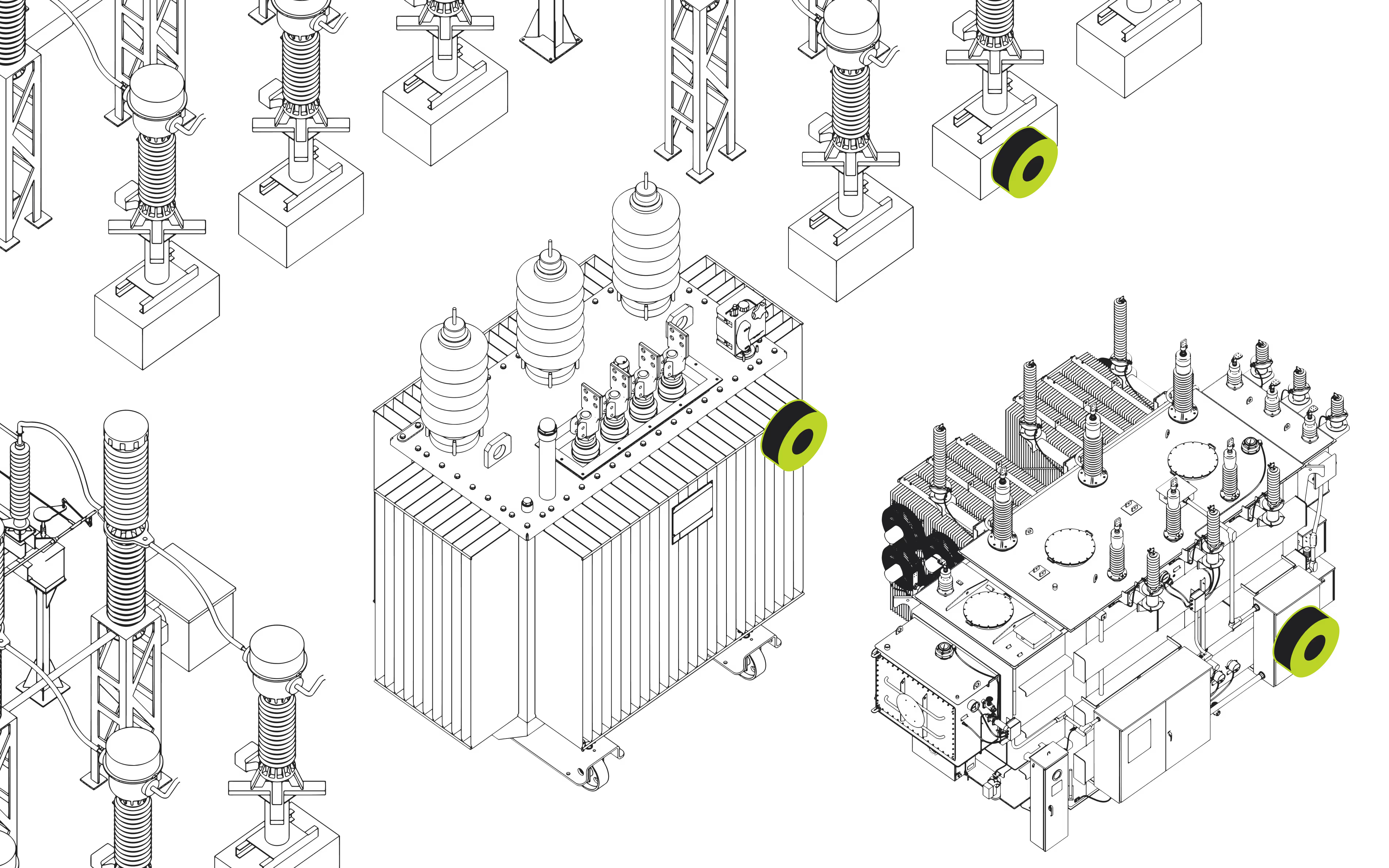
One transformer: Under 30 minutes. Fleet-wide deployment scales without hardware redesign.
By the Numbers
Sensor reliability since launch
Gateway reliability since launch
Prediction Accuracy
To machine health baseline
Frequently Asked Questions
No. VIE sensors mount to the external surface of the transformer tank. Installation requires no de-energization and no modification to transformer internals. The transformer stays fully in service throughout the entire process.
A trained field technician completes installation on a single transformer in under 30 minutes. Fleet-wide deployments scale without hardware redesign.
VIE establishes a machine health baseline for each monitored asset within 30 days of sensor installation. From that point forward, the platform’s models continuously refine as operating data accumulates.
No. The VIE gateway connects to the cloud via LTE or satellite. The platform works in remote substations, offshore facilities, and distributed sites with no existing network.
The myVIE dashboard issues a real-time alert with asset identification, fault classification, risk ranking, and trending data. The typical lead time between a VIE detection and a failure event is 3 to 6 months — enough time to plan, source parts, and schedule the repair on your terms.
No. VIE detects mechanical and electrical failure modes that dissolved gas analysis cannot capture. DGA identifies chemical degradation that vibration monitoring does not cover. The two methods are complementary, not competing. VIE gives operators a reason to use DGA more strategically — targeted to specific assets, at specific moments, rather than on a fixed schedule.
Your Fleet. Fully Visible.
Right Now.
VIE runs on 1000+ transformers across electric utilities, data centers, and critical industrial sites worldwide. KPMG independently validated the ROI. The deployment record speaks for itself.
The question is not whether continuous transformer monitoring works. The question is how long your fleet goes without it.